This post makes the case that model-driven analysis is the analytical foundation of spec-driven development, and that Inteq’s MoDA/Framework™ is the most effective way to produce the kind of build-ready specifications that AI-assisted coding tools, and the engineers and analysts who govern them, actually need.
This is the next logical step beyond the data architecture discipline discussed in our recent post on enterprise-class vibe coding. If business systems analysis is the discipline that keeps vibe coding from becoming an enterprise liability, model-driven analysis is the method that makes that discipline operational and fast.
* * *
The Bottleneck Has Moved Upstream
AI has changed software development, but not in the way many executives first assumed.
Yes, code can now be produced faster. Yes, prototypes can be spun up in minutes. Yes, AI can accelerate design, development, and testing in ways that would have been hard to imagine just a few years ago. The real shift, however, is not that coding has become easy. The real shift is that coding is no longer the primary bottleneck.
The bottleneck has moved upstream.
It now sits in the much harder work of defining, with rigor and clarity, what the business actually needs, how the solution should behave, what constraints must be honored, what data must be managed, what exceptions must be handled, and how success will be verified.
That is why the market is beginning to move from the excitement of vibe coding to the discipline of spec-driven development. Spec-driven development is the right instinct, but the label alone does not solve the problem. What is now being rebranded as “spec-driven development” is, in substance, a rediscovery of something mature organizations have always needed: serious business analysis before serious implementation begins.
The breakthrough is not that specifications suddenly matter. The breakthrough is that AI has made the cost of weak specifications impossible to ignore.
The Problem with Vibe Coding Is Not Speed. It Is Ambiguity.
Vibe coding has a legitimate place. It is useful for experimentation, ideation, internal prototypes, proof-of-concept work, and rough first drafts. Used in the right context, it can compress early-stage exploration and accelerate learning.
The failure mode is not the technique. It is the misuse of the technique. Many organizations are trying to take what is fundamentally a discovery tool and use it as an engineering discipline.
That is where things begin to break down.
If the prompt is vague, the model fills in the blanks. If the business rules are incomplete, the model infers them. If the data relationships are unclear, the model guesses. If exception handling is not defined, the model improvises. If multiple implementation paths seem plausible, the AI may generate one that works technically while completely missing the real business intent.
What looks fast at the beginning becomes expensive later. Teams fall into a cycle of prompt revisions, user re-clarification, partial fixes, recoding, rework, and retroactive testing. The waste is real, but it is often hidden because the output appears so quickly. The organization mistakes motion for progress.
This is not fundamentally a coding problem. It is a requirements problem. And AI magnifies it.
Spec-Driven Development Is Only as Strong as the Specification Feeding It
Spec-driven development depends entirely on what the word “spec” actually means inside an organization. And in practice, that is exactly where most enterprise teams are quietly going wrong.
Some organizations are treating a prose requirements document as the spec. Others are treating a backlog of user stories as the spec. A growing number are treating a PR/FAQ, the Amazon-style working-backwards press release and FAQ, as the spec.
As I argued in “PR/FAQ Is Not a Specification: Using It as Your AI Requirements Document Is Dangerous,” the PR/FAQ is a useful scoping document that earns its place at the very front of the delivery pipeline. But it was never designed to define business processes, data structures, lifecycle states, decision logic, exception paths, or business rules. Treating it as the specification is not spec-driven development. It is vibe coding with a cover sheet.
The pattern is the same regardless of which document is being miscast as the spec. If the artifact handed to the AI coding tool does not rigorously define the process, the data, the rules, the states, and the exceptions, then the AI will fill in the gaps on its own. Every gap becomes an invisible assumption baked into production code. Every unstated business rule becomes an improvised business rule. Every undefined exception path becomes an improvised exception path.
The AI is not being negligent. It is doing exactly what it is designed to do. The negligence is in asking it to do that work in the first place.
That is why spec-driven development cannot be a slogan. It has to be backed by an actual specification method, a method capable of producing the kind of integrated, unambiguous, build-ready blueprint that AI coding tools and engineers can act on without inference. That method is model-driven analysis.
The Organizations That Win with AI Will Not Be the Ones That Prompt the Fastest
They will be the ones that specify the clearest. That is the strategic case for model-driven analysis in the AI era.
If AI is going to participate in design, code generation, testing, and refinement, then the business specification layer must become stronger, more explicit, more structured, and more reusable. Generic prose-heavy requirements documents are not enough. Informal prompts are certainly not enough. Tribal knowledge and hallway conversations are not enough.
AI needs a blueprint.
That is exactly what Inteq’s MoDA/Framework™ is designed to provide.
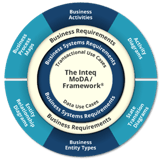
MoDA, Model-Driven Analysis, is built on a simple but powerful idea: use a cohesive set of intuitive, business-oriented visual models to rapidly discover, critically analyze, and clearly blueprint forward-facing business requirements. Those models include process maps, activity diagrams, entity relationship diagrams, and state transition diagrams. Properly applied, they do far more than document requirements. They expose logic. They reveal ambiguity. They structure business knowledge. They create a shared basis for decision-making across business stakeholders, analysts, and technologists.
Those are precisely the things AI should not be left to guess:
• What is supposed to happen?
• What is not allowed to happen?
• What must happen next?
• What data is required, and how is it structured?
• What exception path applies here?
• What states are valid, and what transitions are permitted?
• What business rule governs the decision?
Those are specification questions. They need to be answered before production code is generated, not after the AI has already made a chain of invisible assumptions.
MoDA is not merely a requirements documentation method. It is the business specification layer that makes spec-driven development, and AI-assisted development, enterprise-grade.
Model-Driven Analysis Is the Front End of Model-Driven Development
This is the point most organizations miss. They hear the phrase “model-driven development” and immediately picture downstream technical automation, low-code tooling, or AI code generation. But before development can become truly model-driven, the requirements themselves have to be model-driven.
That is what makes the MoDA/Framework™ so consequential. It is the front end of the pipeline, the analytical discipline that produces the blueprint everything downstream depends on.
Each model in the framework plays a specific role:
A process map defines the major flow, participants, boundaries, handoffs, and exception points.
An activity diagram defines the decision logic, branching, dependencies, loops, and alternative paths.
An entity relationship diagram defines the business data foundation: entities, attributes, relationships, cardinality, and structural dependencies.
A state transition diagram defines lifecycle behavior: valid states, triggering events, permitted transitions, prohibited transitions, and the conditions that govern movement between states.
Together, these integrated models create a far more rigorous specification environment than prose can ever deliver. That is not a cosmetic difference. It is an operational one.
Prose leaves room for interpretation; models reduce it. A vague paragraph can hide assumptions; a well-constructed model exposes them. A loose prompt may sound clear in a meeting yet still leave too much open to AI inference; a visual model forces definition. In an AI-assisted delivery environment, the model is no longer just a communication aid. It becomes a production input.
Professionals who need to develop this data-modeling capability in greater depth can build these skills through Inteq’s Logical Data Modeling course, with practical methods for defining entities, attributes, relationships, cardinality, optionality, and the data-oriented business rules that form the foundation of clear enterprise data requirements.
Rigorous Analysis Up Front Does Not Slow Delivery Down
One of the oldest and weakest objections to rigorous analysis is the claim that it slows delivery down. It does not. Poor analysis slows delivery down. Clear analysis removes delay.
The total end-to-end cycle is almost always shorter when the business thinking is done rigorously at the start because the team does not have to keep going back to users, reinterpreting vague intent, revisiting hidden assumptions, and recoding functionality that was never properly framed in the first place.
This point matters even more now that AI can generate code so quickly. When coding becomes cheaper, bad assumptions become more expensive. That is one of the central business realities of AI-assisted delivery: the faster code gets produced, the more damage unclear requirements can do. Weak thinking gets accelerated. Ambiguity gets operationalized. Defects move downstream faster.
Front-end analysis is not delay. It is compression of downstream waste. It reduces recoding. It reduces misinterpretation. It reduces back-and-forth with business users. It reduces testing churn caused by unclear behavior. It reduces the cost of late clarification. And it reduces the all-too-common “that’s not what I meant” problem that has plagued enterprise delivery for decades.
That is one of the strongest executive arguments for model-driven analysis. It is not about adding documentation. It is about eliminating wasted motion across the entire delivery lifecycle.
The Overlooked Force Multiplier: Models Can Drive AI-Assisted Testing
There is another point enterprise leaders should take seriously. The same requirement models used to specify the business solution can also drive AI-assisted automated testing.
That is a major structural advantage.
If a process map defines the normal flow and exception paths, those paths become test scenarios. If an activity diagram defines decision branches, those branches become rule-based test cases. If a state transition diagram defines valid and invalid status changes, those transitions become positive and negative test conditions. If an entity relationship diagram defines entities, relationships, and integrity constraints, those elements inform schema validation, data integrity checks, and interface testing.
This fundamentally changes the economics of requirements work. The model is no longer an artifact that gets created at the front end and quietly abandoned once coding begins. It becomes a reusable enterprise asset across analysis, design, implementation, testing, and governance.
That is a far stronger delivery model than asking AI to improvise code from prompts and then trying to reverse-engineer what the intended business behavior was supposed to be.
AI Should Also Help Refine the Model Before Development Begins
There is a high-value opportunity here that most organizations are underusing: AI should not be used only after the requirements are done. It should also be used during model-driven analysis.
This is where AI becomes a force multiplier for business analysts and subject matter experts. An analyst can draft the initial process map, activity diagram, data model, or state model, and then use AI to interrogate it. AI can surface likely ambiguities, identify missing edge cases, expose unstated assumptions, and generate the questions that should be validated with business SMEs:
• What triggers this exception path?
• What happens when required data is missing?
• Can this entity move directly from one state to another?
• Who authorizes the override?
• What business rule constrains this decision?
• What happens if this event occurs out of sequence?
• What downstream impact occurs if this handoff fails?
Used this way, AI becomes a disciplined challenge mechanism during analysis, not just a code generator after the fact. That matters because most defects in enterprise systems do not originate in coding errors. They originate in misunderstood process logic, incomplete exception handling, undocumented business rules, shallow discovery, and poorly defined state behavior.
A stronger operating model looks like this:
That is a fundamentally more disciplined approach than prompt-first, fix-later.
The Correct Sequence for Spec-Driven, AI-Assisted Development
Put the pieces together and the correct sequence for spec-driven, AI-assisted development becomes clear:
This is what spec-driven development actually looks like when it is done right. It is also the combination that most organizations are skipping. Each step in this sequence has a distinct failure mode when it is skipped or collapsed into another.
The failure modes compound. The cost of getting the sequence wrong is not additive. It is multiplicative.
Why This Matters Commercially, Not Just Conceptually
This is not an academic distinction. It is a practical business issue for organizations trying to modernize legacy applications, redesign business processes, implement AI agents, improve delivery quality, reduce implementation risk, and strengthen governance.
The organizations that build the clearest business blueprints will extract more value from AI than the organizations that do not. The ones that continue to rely on vague prose, fragmented tribal knowledge, and loosely framed prompts will generate more churn, more rework, and more downstream confusion regardless of how impressive their initial demos look.
That is why model-driven analysis deserves renewed executive attention. Not because requirements work needs a new label. But because in an AI-assisted world, clarity itself has become a strategic capability.
The fastest way to create that clarity is not with more meetings, more prose, or more prompt tinkering. It is with rigorous, business-oriented visual models that expose the real logic of the business before code gets produced.
That is the commercial case for MoDA’s model-driven analysis approach. It gives organizations a disciplined way to convert business complexity into AI-ready specifications. It gives analysts a stronger method for discovering and refining forward-facing requirements. It gives architects and engineers a clearer blueprint to design from. It gives AI coding tools better inputs. It gives QA teams better sources for automated test generation. And it gives executives more confidence that speed is not being purchased at the expense of fit, control, and maintainability.
The Bottom Line
The market is beginning to understand something important: AI-generated code is not the same thing as AI-enabled engineering.
Real engineering still requires business clarity. It still requires structure. It still requires explicit rules, defined data, valid states, and testable behavior. The difference now is that organizations can no longer afford to leave any of those things implicit. AI will fill every gap, and it will fill them with guesses.
The message is clear: Do not ask AI to build important systems from vibes. Do not ask it to build from a press release, a backlog, or a paragraph of prose either. Ask AI to build from models. If you want spec-driven development to work, start with model-driven analysis and let the MoDA/Framework™ produce the specification that everything downstream depends on.
Ready to Move Beyond AI-Assisted Coding Experimentation?
Inteq can help you:
Contact us at info@inteqgroup.com | 800.719.4627
* * *
Related Posts:
The Secret Sauce to Unlocking Agentic AI
The Uncomfortable Truth About AI Agents
The Secret Sauce of Enterprise-Grade Agentic AI
Agentic AI - Breaking the Myth of the Iron Triangle
Why AI Agents Often Fail to Improve Business Processes
* * *
Visit our Insights Hub
Visit my YouTube Channel | Connect with me on LinkedIn
Check out our business analysis Training Courses and Consulting Services
Contact us at info@inteqgroup.com