Executive Summary: Enterprise agentic AI often struggles to scale not because of weak platforms, but because agents are reasoning against inconsistent or absent representations of the business itself. The platform decision is second-order. The first-order decision is whether the enterprise has rigorously defined its data-oriented business rules, including entities, attributes, relationships, and states.
Today, agent definitions of "customer," "order," or "claim" often come from prompts, developer assumptions, or whichever system was queried first. Enterprises hold separate definitions across CRM, ERP, and operational systems. Agents inherit those inconsistencies as decision-making defects. Multiple agents can compound the problem. The result may work in demonstrations and break in production.
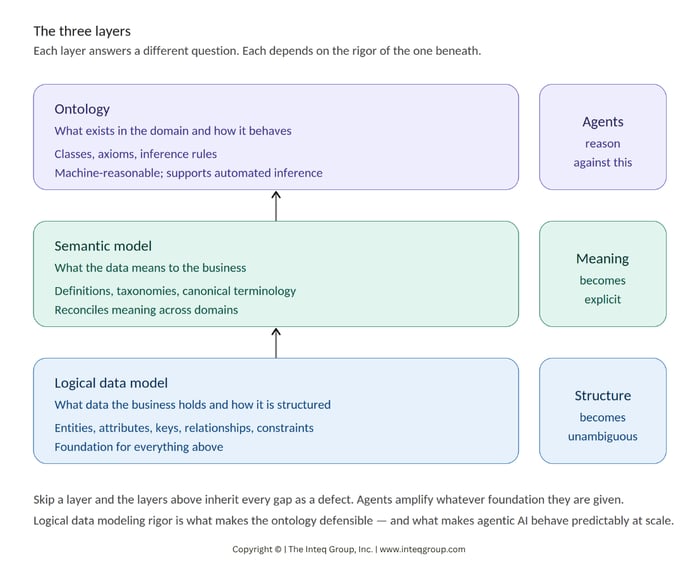
Buying an ontology platform produces a container, not an answer. The answer comes from analytical discipline, specifically the rigorous logical data modeling practice that mature business systems analysis has relied on for decades. A well-executed logical data model provides a precise representation of how the business understands its core data-oriented concepts and rules, establishing the foundation from which semantic and ontology layers can be built.
Logical data modeling is a foundational discipline within MoDA/Framework™, Inteq's model-driven analysis methodology for creating precise, shared business meaning across systems, processes, data, and requirements.
* * *
The Quiet Differentiator Most Agentic AI Strategies Miss
The agentic AI market is saturated with platform claims. Vendors across every adjacent category, including RPA incumbents, iPaaS leaders, workflow automation platforms, customer service specialists, and developer frameworks, are positioning their products as the definitive foundation for enterprise agentic AI automation.
Executive audiences are being told, with increasing confidence, that the platform choice is the decisive one.
It Isn't
The platform choice matters, but it is a second-order decision. The first-order decision, and the one many enterprises are getting wrong, concerns what the agents are reasoning about.
Agentic AI does not fail at scale simply because the orchestration engine is weak, the connectors are limited, or the models are insufficiently capable.
It fails when agents are reasoning against an inconsistent, ambiguous, or absent representation of the business itself.
This is the agentic AI ontology question. And it is becoming a real differentiator separating enterprises that can scale agentic AI from those still stuck in proof-of-concept cycles.
What Is the Agentic AI Ontology Question?
Strip away the terminology and the question is simple: when an agent decides what a "customer" is, what constitutes an "order," when a "claim" is considered "resolved," or how a "product" relates to a "contract," where does that definition come from?
In many current enterprise agentic AI deployments, the answer is uncomfortable. The definitions come from prompts. They come from the tacit assumptions of whichever developer or AI engineer wired up the agent's tools.
They may come from whichever system of record happened to be queried first. They may come from the LLM's training data, where "customer" means whatever it statistically tends to mean across broad contexts.
The problem is that enterprises rarely have one definition of customer. They have the sales definition, the finance definition, the support definition, the marketing definition, and the regulatory definition, each encoded differently across CRM, ERP, data warehouses, and operational systems.
When a single agent traverses these systems to complete a process, it inherits every inconsistency as a decision-making defect. When multiple agents coordinate, the inconsistencies can compound.
The ontology question is whether the enterprise has a rigorous, governed, shared representation that defines its entities, their attributes, their relationships, their meaning, and their business rules, and whether agents reason against that enterprise definition rather than whatever they happen to encounter first.
Why This Is an Analytical Discipline Problem, Not a Technology Problem
The instinct in many organizations is to treat this as a tooling question. It is not.
Ontology platforms, knowledge graphs, semantic layers, and related technologies are valuable, but they are containers for an answer the business must first produce. The analytical work begins with a rigorous logical data model, extends through semantic reconciliation, and can then be formalized into an ontology suitable for machine reasoning.
The answer is produced by analytical discipline, specifically by the rigorous logical data modeling practice that mature business systems analysis has relied on for decades.
Logical data modeling forces the precise questions that agents need answered. What are the entities this business actually operates on? What uniquely identifies each one? What attributes belong to each, and which are authoritative? What relationships exist among them? What business rules govern their behavior and state transitions? What constraints must always hold?
These are not database questions. They are business questions. The deliverable of a well-executed logical data model is not merely a schema. It is a rigorous, unambiguous representation of the business's data-oriented rules and relationships, providing the foundation for the semantic and ontology layers that agentic systems need for more predictable behavior.
Organizations that need to strengthen this analytical foundation can build these capabilities through Inteq's Logical Data Modeling training, with practical methods for defining entities, attributes, relationships, cardinality, optionality, and the data-oriented business rules that enterprise systems and AI agents depend on.
The Predictability Problem Agentic AI Cannot Solve on Its Own
Large language models are probabilistic. Their outputs are distributions over possibilities. This is not a defect. It is part of the mechanism by which they generalize and handle novelty.
But it means that an agent, left to its own interpretive devices, may occasionally decide that two records represent the same customer when they do not, that an order is complete when a downstream system still considers it open, or that a claim qualifies for a category that regulation prohibits.
The conventional response is to layer guardrails: human-in-the-loop checkpoints, validation steps, evaluation suites, and structured output schemas. These are necessary. They are not sufficient.
Predictability improves when the semantic space in which the agent operates is constrained by rigorously defined enterprise meaning. When "customer" has a governed definition, when the state of an order is explicit, and when business rules are defined rather than inferred, the surface area for interpretation is reduced.
The AI agent is no longer inventing business meaning. It is operating within meaning that the business has already defined and governed.
This is why disciplined logical data modeling and semantic modeling create such an important foundation for enterprise agentic AI. The foundation does work that the platform alone cannot.
The Strategic Implication for Senior Leadership
For C-suite and senior IT leaders, the practical implication is worth stating directly: the agentic AI platform decision, however consequential, is downstream of a more important decision. That decision concerns the rigor of the enterprise's logical data modeling practice and the discipline with which it is applied to the business processes being automated.
Organizations that invest in agentic AI without that foundation are building on weak ground. They may produce demonstrations, pilots, and limited-scope deployments that perform well enough to sustain funding for a period of time. Eventually, however, accumulated semantic inconsistencies across systems can create unpredictable agent behavior, erode trust, complicate audits, and increase operational risk.
Organizations that invest in the analytical foundation first, or in parallel, experience a different trajectory. Their agents operate within a more disciplined semantic environment. Their governance effort becomes more tractable because business meaning and constraints are defined more explicitly. Their platform choice can then be made on operational, architectural, and commercial criteria rather than being expected to compensate for unresolved analytical ambiguity.
Inteq-in-the-Loop (IITL)
At Inteq, our body of knowledge, developed across decades of consulting engagements, professional training programs, and published thought leadership, has consistently emphasized logical data modeling as a foundational analytical discipline for enterprise systems.
Logical data modeling is a foundational discipline within MoDA/Framework™, Inteq's model-driven analysis methodology for creating precise, shared business meaning across systems, processes, data, and requirements.
That positioning was correct when systems were human-operated, correct when they were automated with traditional rules engines, and correct when they were reshaped by RPA. It is even more important now that these systems are increasingly operated by agentic AI.
Agents inherit whatever semantic rigor, or lack of it, the business has committed to. Where rigor exists, organizations have a stronger foundation for scale. Where it does not, ambiguity becomes operationalized.
The organizations that treat this as a first-order agentic AI question, rather than a detail to be handled later, will be better positioned to capture the value the technology makes available.
* * *
Related Posts:
The Uncomfortable Truth About AI Agents
Data, Meaning, Reasoning - and Agentic AI
The Secret Sauce of Enterprise-Grade Agentic AI
Agentic AI - Breaking the Myth of the Iron Triangle
Why AI Agents Often Fail to Improve Business Processes
The Secret Sauce to Unlocking Enterprise Class Vibe Coding
Spec-Driven Development Starts with Model-Driven Analysis
* * *
Visit our Insights Hub
Visit my YouTube channel | Connect with me on LinkedIn
Check out our Business Analysis Training Courses and Consulting Services