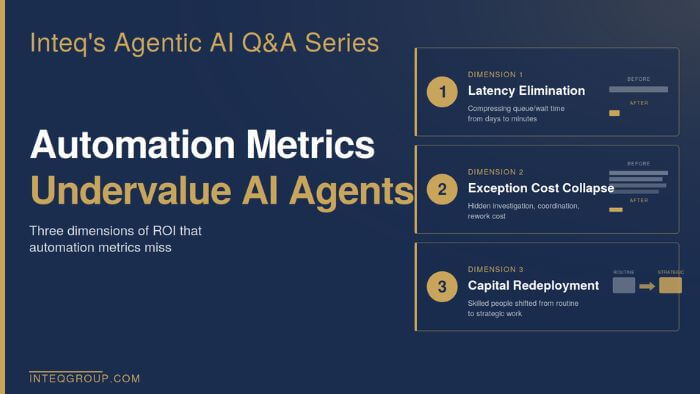
Inteq's Agentic AI Q&A Series
Question: How Do You Measure the ROI of AI Agents?
Answer: AI agent ROI is measured incorrectly by most organizations because they apply automation-era metrics to a fundamentally different capability. Traditional automation ROI focuses on task speed such as processing an invoice faster or routing a request faster. This framing produces modest, incremental business cases that struggle to justify Agentic AI investment. The decision-flow economic case is fundamentally different because it measures value in three dimensions that traditional automation does not touch.
The first dimension is decision latency elimination. Decision latency is the elapsed time work items spend waiting for human judgment - sitting in queues, awaiting approval, awaiting interpretation, awaiting cross-functional coordination. In most enterprise processes, decision latency accounts for 70-90 percent of total cycle time. Compressing this latency from days to minutes is an order-of-magnitude improvement, not an incremental one.
For example, a routine invoice that previously moved through the process in 3-7 business days now completes in minutes when the agent makes the routine decisions autonomously; A price variance that previously required 5-12 days of cross-functional investigation completes in hours when the agent reasons over contract terms and historical patterns directly.
The second dimension is exception handling cost collapse. The fully-loaded cost of investigating, coordinating, and resolving exceptions, including senior analyst time, manager review, cross-functional coordination, vendor communication, rework cycles, etc. - is one of the largest hidden costs in enterprise operations. Agents that reason over exceptions contextually collapse this cost by resolving what human queues currently absorb. In exception-heavy processes (35 percent or more exception rates), this is often the largest single source of agent value, dwarfing the value created by accelerating the happy path.
The third dimension is human capital redeployment. The value created when skilled professionals shift from routine cognitive work, reviewing clear matches, applying standard policies, approving straightforward transactions, etc., to strategic work that only humans can do, including complex negotiation, novel exception resolution, process improvement, and relationship management. This is the most underestimated dimension of agent ROI because it does not appear as a line-item cost reduction; it appears as increased capacity for the work that creates competitive advantage.
The proper economic methodology is Agent Value Stream Mapping: map the current-state process step by step with elapsed time, queue time, exception cost, and human time at each decision point, then map the future-state process with the same lens. The difference is the agent ROI. Organizations that frame the case this way produce business cases that are both more accurate and more compelling than traditional automation business cases because they measure the dimensions where agents create their distinctive value, not the dimensions where automation already performs well.
* * *
Related Q&A:
How Is Agentic AI Different from RPA and Traditional Automation?
Which Business Processes Are Best Suited for AI Agents?
How Do I Identify the Right Business Processes for AI Agents?
Related Consulting Services:
Agentic AI Readiness & Strategy Analysis
AI Agent Opportunity & Portfolio Design
Business Process Mapping
Process Improvement & Reengineering
Related Training Courses:
Discovering Agentic AI Opportunities
Analyzing and Specifying AI Agent Business Requirements
* * *
Visit our Insights Hub
Visit my YouTube Channel | Connect with me on LinkedIn
Check out our business analysis Training Courses and Consulting Services
Contact us at info@inteqgroup.com