Inteq's Agentic AI Q&A Series
Question: How Do I Identify the Right Business Processes for AI Agents
Answer: Identifying the right business processes for AI agents requires a structured three-stage methodology that moves from a broad portfolio of candidate processes to a prioritized shortlist of high-impact opportunities with clear next steps. Each stage produces a specific output and applies specific analytical instruments, transforming process selection from intuition into a defensible discipline.
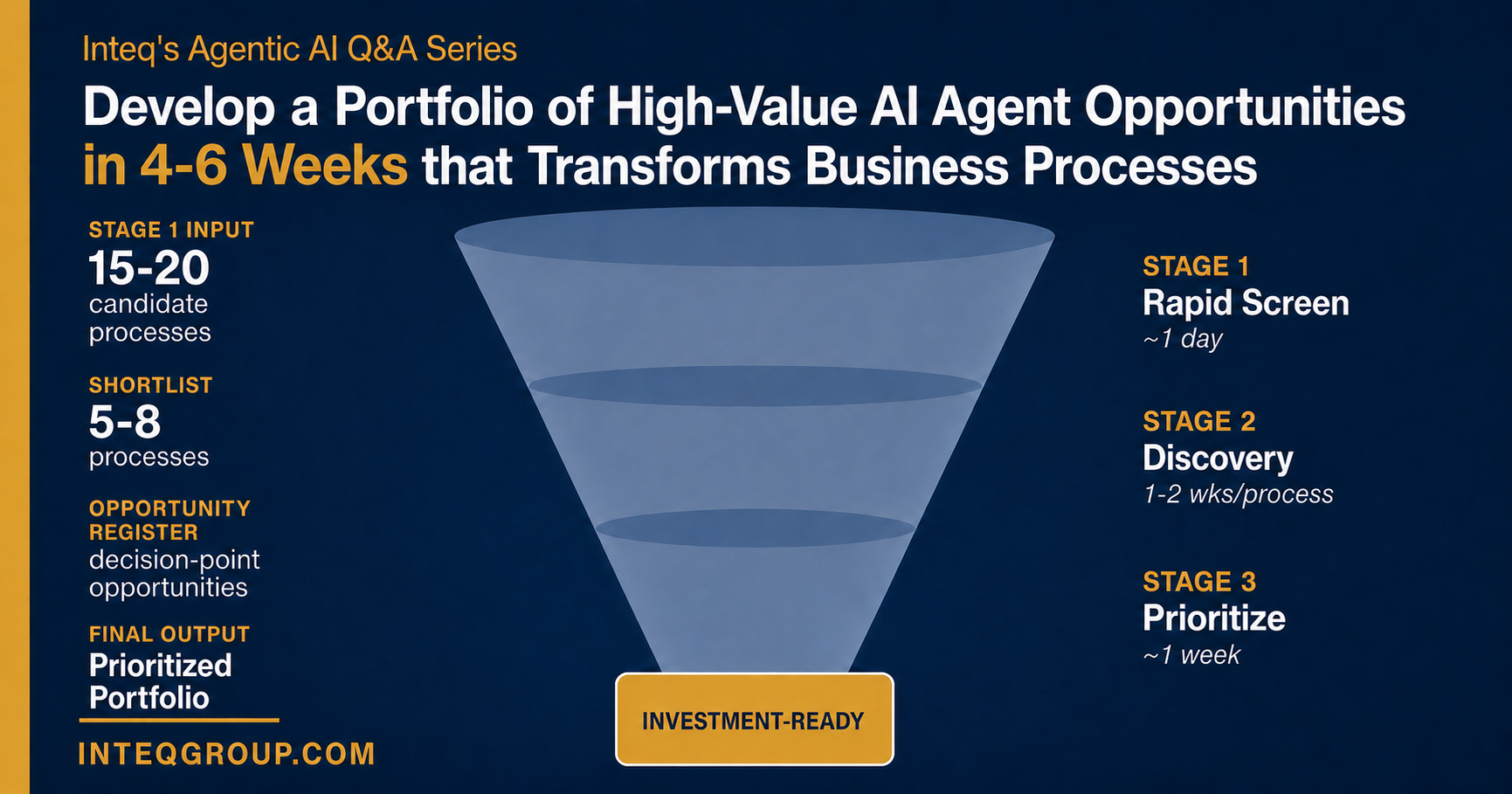
Stage 1 is the Rapid Screen, executed in approximately one day. Apply three markers to your top 15-20 candidate processes: decision density (how many judgment calls, classifications, and contextual evaluations occur within the process), exception volume (what percentage of instances deviate from the happy path), and data confidence readiness (whether the data required for key decisions is digitally accessible, reliable, and current). Score each process as high, medium, or low on each marker. Processes that score high on all three advance. This eliminates 60-70 percent of candidates in a single exercise - focusing subsequent analytical effort on the genuinely viable opportunities.
Stage 2 is the Discovery Deep-Dive, executed in 1-2 weeks per shortlisted process. Apply the five discovery lenses to identify the specific decision points and activities where agents create value: Cognitive Task Analysis reveals where the process demands judgment versus rule-following; Decision Authority Mapping identifies every decision point and whether it can be delegated to an agent; Information Flow Analysis traces where information gets stuck or degraded; and the remaining lenses uncover patterns invisible to traditional process assessment. Classify each identified decision point by cognitive complexity and delegation potential using the five-tier autonomy taxonomy. This stage produces the opportunity register - a catalogue / pipeline of specific, scoped agent opportunities within each process, defined at the decision-point level rather than the process level.
Stage 3 is the Prioritized Portfolio, executed in approximately one week. Score each opportunity from the register across four dimensions: business value, technical feasibility, risk tolerance, and organizational readiness. Plot the opportunities on a value-feasibility matrix to identify Quick Wins (high value, high feasibility), Strategic Bets (high value, lower current feasibility but worth pursuing as enablement work proceeds), and Future Opportunities (lower priority for current investment). Sequence the prioritized opportunities by dependencies - some opportunities require shared infrastructure or capability assets that earlier deployments will produce. Present the prioritized portfolio to leadership for investment decision.
Professionals and teams responsible for applying this methodology can build these capabilities through Inteq’s Discovering Agentic AI Opportunities. The course provides structured methods for discovering candidate AI agent opportunities, evaluating business value and agentic readiness, determining appropriate levels of autonomy, and prioritizing opportunities into a defensible enterprise portfolio.
The methodology is deliberately structured for execution. Stage 1 takes a day and produces a defensible shortlist. Stage 2 takes 1-2 weeks per process and produces specific, scoped opportunities. Stage 3 takes a week and produces an investment-ready prioritized portfolio. Total elapsed time from broad portfolio to investment-ready opportunities: typically 4-6 weeks for an organization screening a meaningful set of candidates. This is dramatically faster than the typical organic discovery process, which often takes 3-6 months and produces less defensible results.
* * *
Related Q&A:
Which Business Processes Are Best Suited for AI Agents?
Why Do AI Agent Initiatives Fail?
How Do You Measure the ROI of AI Agents?
Related Consulting Services:
Agentic AI Readiness & Strategy Analysis
AI Agent Opportunity & Portfolio Design
Business Process Mapping
Process Improvement & Reengineering
Related Training Courses:
Discovering Agentic AI Opportunities
Analyzing and Specifying AI Agent Business Requirements
* * *
Visit our Insights Hub
Visit my YouTube Channel | Connect with me on LinkedIn
Check out our business analysis Training Courses and Consulting Services
Contact us at info@inteqgroup.com