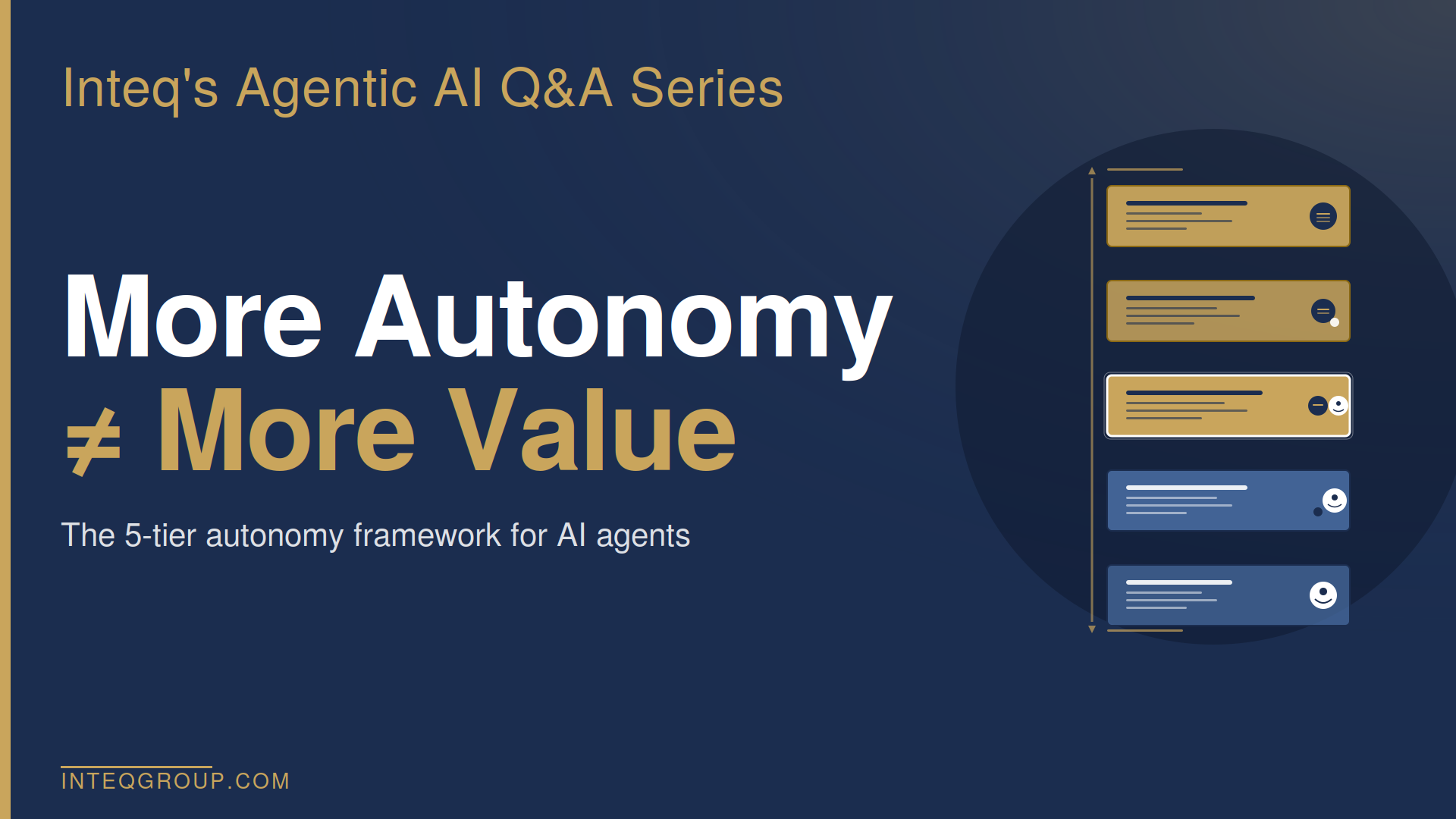
Inteq's Agentic AI Q&A Series
Question: How Do I Decide Which Decisions an AI Agent Should Make Autonomously?
Answer: Agent autonomy is not a binary choice between “the agent decides” and “the human decides.” It is a five-tier classification applied to each decision point within a process: Fully Autonomous, Human-on-the-Loop, Human-in-the-Loop, Human-Initiated, and Human-Only. The right tier for each decision is determined by three factors: the cognitive complexity of the decision, the data confidence available at the point of decision, and the consequence of getting the decision wrong.
The Five-Tier Autonomy Framework That Re-Orients Where Agent Investments Actually Create Value
Agent autonomy is not "the agent decides versus the human decides." It is a five-tier classification applied to each decision point within a process.
• Fully Autonomous decisions are those where the agent has explicit logic, reliable data, and bounded consequences - the decision can be made and executed without human involvement. For example, classifying incoming invoices by type, applying standard GL coding for established vendor patterns, and scheduling routine payments within defined cash management policy. The agent decides; humans review aggregate patterns periodically rather than individual decisions.
• Human-on-the-Loop decisions are made autonomously by the agent, but humans monitor in real time and can intervene if patterns deviate from expectations. The agent acts; humans observe. This tier is appropriate for decisions with moderate consequence where post-hoc correction is feasible. For example, exception resolution within defined tolerance thresholds.
• Human-in-the-Loop decisions require human confirmation before the agent executes. The agent proposes; the human approves or revises. This tier suits decisions where consequence is high, reversibility is limited, or organizational policy requires human accountability. For example, credit decisions above defined thresholds, exception approvals that exceed tolerance limits, and any decision that crosses a regulatory line where human accountability is non-negotiable.
• Human-Initiated decisions are made by humans but with agent support. The agent provides analysis, recommendations, and pre-assembled context; the human decides. This tier preserves human ownership of strategic and judgment-intensive decisions while leveraging agent capability to make the human more effective.
• Human-Only decisions are reserved from the agent entirely. These are decisions involving novel ethical questions, fundamental policy choices, situations of high political or relational sensitivity, or any context where the organization has determined human accountability cannot be delegated. The agent does not participate in these decisions, even in an advisory role.
The Three Factors That Determine the Tier
The right tier for any given decision is determined by three factors working together.
First is the cognitive complexity of the decision - how much reasoning, pattern recognition, and judgment the decision actually requires.
Second is the data confidence available at the point of decision – the level of reliability, completeness and authoritativeness of the inputs that the agent uses.
Third is the consequence of getting the decision wrong - what happens, and to whom, when the decision turns out to be incorrect.
These factors interact. A decision can have low cognitive complexity but high consequence (a routine payment of $50,000 versus $50). A decision can have high cognitive complexity but low consequence (categorizing an ambiguous customer inquiry where any of three categories would lead to similar handling). The autonomy tier follows from the specific combination of these three factors at the specific decision point - not from the decision type, not from the process category, and not from the agent's technical capability.
Where The Actual Value Lives
Here is the strategic point that re-orients agent investment decisions. The most valuable agent opportunities are often at the Human-on-the-Loop or Human-in-the-Loop tiers, not at the Fully Autonomous tier.
The reason is straightforward. Fully Autonomous decisions, by definition, are the decisions with the lowest consequence, highest data confidence, and most explicit logic. They are the easiest decisions to automate, and therefore typically the lowest-value decisions in the process. The cognitive work the experienced human is performing on those decisions is minimal, so removing the human from the loop produces a minimal capability gain.
The high-stakes decisions, where experienced people add real cognitive value, are usually higher in consequence, lower in data confidence, or both. These cannot be Fully Autonomous because the consequence of error is too high. But they can be made enormously more efficient by an agent operating at Human-on-the-Loop or Human-in-the-Loop tier. The agent does the data gathering, the pattern recognition, the routine analysis, and generates options. The human does the judgment. The combined output is faster and better than either alone.
Organizations that pursue agent investment with the implicit goal of "more autonomy is better" consistently allocate their spending to the wrong tier. They build Fully Autonomous agents for low-value decisions and leave the high-value decisions untouched. Organizations that perform autonomy classification rigorously during discovery, before any agent is built, consistently identify the right opportunities and build the right agents.
The autonomy classification is performed during discovery, before any agent is built. It directly determines the agent’s role, the human’s role, and the governance design for the process. The most valuable agent opportunities are often at the Human-on-the-Loop or Human-in-the-Loop tiers, where the agent does the cognitive work and the human provides judgment on the highest-stakes decisions, not at the Fully Autonomous tier, which is reserved for the lowest-consequence, highest-confidence decisions.
The classification is the discipline. Get it right, and the agent matches the work. Skip it, and the agent gets built where it's easy rather than where it matters.
* * *
Related Q&A:
How Do You Formally Model SME Tacit Knowledge and Decision Logic for AI Agent Design?
How Is Agentic AI Different from RPA and Traditional Automation?
How Do You Measure the ROI of AI Agents?
Related Consulting Services:
Agentic AI Readiness & Strategy Analysis
AI Agent Opportunity & Portfolio Design
Business Process Mapping
Process Improvement & Reengineering
Related Training Courses:
Discovering Agentic AI Opportunities
Analyzing and Specifying AI Agent Business Requirements
* * *
Visit our Insights Hub
Visit my YouTube Channel | Connect with me on LinkedIn
Check out our business analysis Training Courses and Consulting Services
Contact us at info@inteqgroup.com