Architect how people and AI agents understand, reason, decide, and act.
AURA/Framework is Inteq's framework for agentic AI decision architecture - transforming business processes from task-flow to decision-flow architecture and defining how decision authority, evidence, autonomy, human oversight, escalation, and action are designed across people and AI agents within one governed operation.
Agentic AI changes the nature of business process design. Unlike traditional automation, AI agents can interpret context, exercise bounded judgment, and act - making judgment itself something the organization can deliberately allocate across people and AI agents.
Automates defined tasks and rules within a predetermined workflow.
Introduces AI agents that can interpret information, reason within context, exercise defined judgment, and determine what action should occur next.
Some decisions can be exercised by AI agents, some should remain with people, and others are best performed collaboratively. The important question is no longer simply whether an activity can be automated, but how judgment should be allocated within the operating process.
AURA provides the discipline for making that allocation deliberately - defining who or what makes each decision, what evidence is required, how much authority is appropriate, when escalation is mandatory, and where human oversight remains essential.
The question is no longer simply what should be automated. It is how decision authority should be allocated across people and AI agents - with the appropriate boundaries, accountability, and oversight.
AURA provides a structured discipline for designing how judgment operates within an agentic business process, connecting business context, reasoning, decision authority, human oversight, and action within one governed operating architecture.
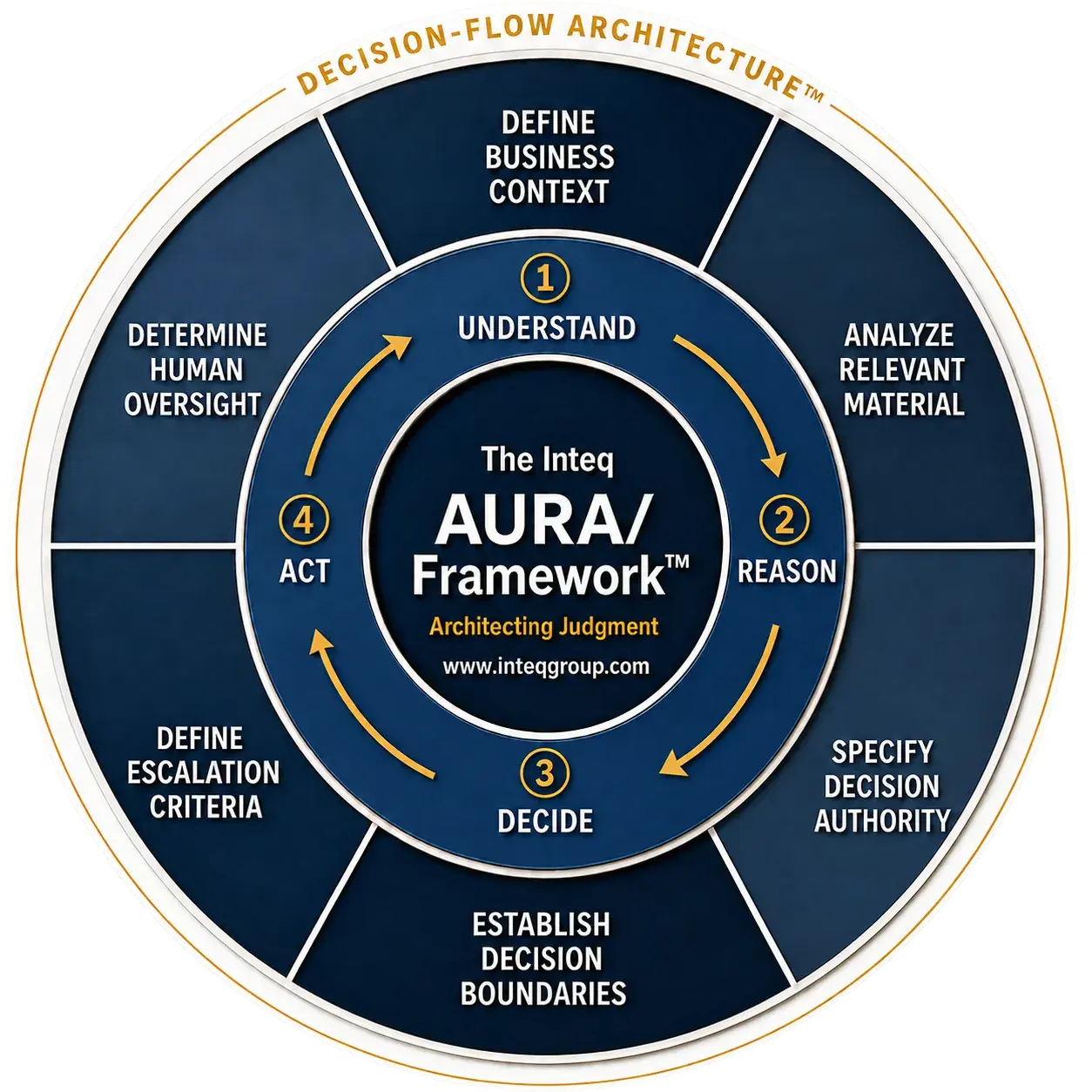
AURA makes the decision architecture of the process explicit, showing how people and AI agents understand context, reason, exercise judgment, make decisions, operate within defined authority, and translate decisions into governed action.
Traditional business processes are designed primarily as task-flows: sequenced activities that execute defined rules and move work from one step to the next. Introduce AI agents that can interpret context and exercise bounded judgment, and the process architecture changes. The operation must now be designed around the decisions that move the work forward.
Traditional process design organizes work primarily around the activities required to move from one step to the next. Tasks are sequenced, rules define expected behavior, and people exercise judgment where the workflow requires interpretation or discretion.
Agentic process design makes the decisions inside the operation explicit. The process is architected around where judgment occurs, what information and evidence support it, who or what should exercise it, and how each decision advances the work.
The shift from task-flow to decision-flow must be architected, not assumed.
AURA redesigns the process around where judgment is exercised, how authority is allocated, and how decisions translate into action - so agentic capability transforms the operation rather than simply accelerating the existing workflow.
When AI agents participate directly in business decisions and actions, governance must extend beyond policies surrounding the technology and into the operating process itself. Decision authority, required evidence, operating boundaries, escalation, and human oversight must be deliberately designed into how the work is performed.
Autonomy without architecture creates exposure. AURA defines the level of authority appropriate to each decision rather than assuming that maximum agent independence is inherently better.
The objective is governed decision-making that is visible to leadership, explainable in operation, and defensible against the organization's defined controls and responsibilities.
Specify the decisions an AI agent is authorized to make and the actions it may take within the scope of its defined role.
Define the information, business context, rules, and supporting evidence required before an agent may exercise a decision or take action.
Establish the thresholds, conditions, risk limits, and other constraints beyond which an agent is not permitted to act autonomously.
Identify the conditions that require a decision to move to another agent, a higher authority level, or a human participant for review or action.
Determine where human judgment, review, approval, intervention, or accountability must remain an explicit part of the operating process.
AURA makes agent autonomy an explicit architectural decision visible to leadership, embedded in the process,
and governed according to the authority, evidence, boundaries, and oversight each decision requires.
Agentic transformation is not a replacement program. It is a deliberate allocation of judgment - defining what AI agents can decide within governed boundaries and where human experience, context, accountability, and discretion remain essential.
Some decisions can be exercised reliably by AI agents within defined authority, evidence requirements, and operating boundaries. Others depend on human experience, contextual understanding, accountability, or discretion that should remain part of the process.
AURA makes that division explicit so the operating model is designed around the strengths and responsibilities of both people and AI agents rather than treating human involvement as an exception to automation.
Situations that fall outside established patterns or decision boundaries and require informed human intervention.
Decisions where incomplete information, competing considerations, or uncertain context make human interpretation especially important.
Work where trust, experience, organizational context, and interpersonal judgment are central to the outcome.
Decisions where organizational accountability, responsibility, or the nature of the judgment requires a person to remain the decision maker.
AURA elevates human judgment by concentrating it where experience, context, accountability, and discretion matter most - while giving AI agents defined authority to operate effectively within governed boundaries.
Agentic transformation can create value beyond any single deployment. When decision patterns, governance practices, operating evidence, and experience are captured systematically, each deployment strengthens the organization's ability to identify, design, govern, and scale the next agentic AI opportunity.
AURA provides a repeatable discipline for capturing what the organization learns about decision design, agent authority, governance, human oversight, and operational performance. That knowledge becomes part of the enterprise foundation for subsequent agentic AI initiatives.
The organization develops a stronger understanding of where agent judgment creates value, where human judgment remains essential, and how decision authority should be structured across different operating situations.
Authority models, escalation structures, evidence requirements, oversight practices, and accountability mechanisms become more established and reusable across future agentic processes.
Each deployment produces practical evidence about agent performance, decision quality, exceptions, controls, and human-agent interaction that can inform the design and governance of subsequent opportunities.
Each deployment can make the next opportunity easier to recognize, more disciplined to govern, and more efficient to design and implement.
The objective is not a portfolio of disconnected AI agent deployments. It is an enterprise agentic capability that becomes more mature, governed, and repeatable with each deployment.
AI agents inherit the strengths and weaknesses of the business processes they operate within. Deploy agentic capability into a process burdened by unnecessary complexity, weak decision logic, poor-quality data, or unresolved process debt, and those problems can be operationalized at greater speed and scale.
AURA does not require every process-transformation activity to be completed before agent development begins. Agent analysis, design, development, and validation can advance alongside the work required to prepare the business process for responsible deployment.
Determine where agentic capability can create meaningful value within the business process.
Define the decisions, evidence, authority, autonomy, escalation paths, and human-agent interaction required.
Develop and test the agentic capability against the defined operating requirements, decision architecture, and governance controls.
Assess the process, business rules, data, knowledge, handoffs, controls, and decision structures the agent will operate within.
Retire process debt, unnecessary complexity, weak decision structures, and other conditions that would undermine agentic performance.
Establish the operating environment, controls, information, and organizational conditions required for responsible deployment.
The gate governs deployment, not development. Agentic capability moves into the operating process only when the process is ready to support it with the required integrity, decision architecture, governance, and organizational controls.
Enterprise speed and enterprise discipline do not have to compete. AURA advances agent development
and process readiness in parallel while preserving a clear standard for responsible deployment.
AURA extends Inteq's established business analysis and process transformation discipline into the agentic era. The focus remains the same: understand the work precisely, distinguish mechanical execution from knowledge and judgment, and design the operating model deliberately rather than allowing technology to define it by default.
Inteq's analytical discipline has long examined work at a deeper level than its visible workflow — separating activities that are primarily mechanical and rules-based from work that depends on knowledge, interpretation, judgment, and decision-making.
That analytical lineage is reflected in James Proctor's Mastering Business Chaos, which formalized Inteq's discipline of distinguishing mechanical, rules-based work from work driven by knowledge and judgment.
Agentic AI makes that distinction more consequential because portions of judgment can now be exercised by AI agents. AURA extends the analytical lens to determine where that capability belongs, how it should operate, and where human judgment must remain.
Activities that can be defined through explicit rules, repeatable logic, structured inputs, and predictable execution.
Work that requires interpretation, context, evaluation, discretion, and decisions that cannot be reduced entirely to mechanical execution.
AURA extends the analysis to determine how judgment should be allocated across people and AI agents, with explicit authority, evidence, boundaries, escalation, and oversight built into the operating process.
AURA brings the rigor of business analysis and process transformation to a new question: how should judgment be designed when both people and AI agents can participate in the decisions that run the business?
AURA is the cognitive layer within Inteq's three-framework methodology suite. Together, MoDA, BPR360, and AURA address how the business defines meaning, how work operates, and how judgment flows across people and AI agents.
MoDA operates on the semantic layer, creating governed definitions of the business through data models, business rules, decision logic, states, requirements, and related business specifications. This semantic foundation provides precise business meaning for analysis, transformation, systems, and AI reasoning.
BPR360 operates on the operational layer, examining how work flows across the enterprise, identifying process debt and structural inefficiencies, and reengineering the end-to-end process for stronger performance, coordination, and execution.
AURA operates on the cognitive layer, architecting how people and AI agents understand context, reason, exercise judgment, make decisions, operate within authority, escalate exceptions, and translate decisions into governed action.
Together, the three frameworks create an integrated discipline for defining the business precisely,
transforming how work operates, and architecting how judgment is exercised across people and AI agents.
For agentic transformation, the methodology suite connects semantic precision, process readiness, and decision architecture, helping ensure that AI agents operate within business processes that are clearly defined, operationally sound, and governed for the decisions they are expected to make.
AURA is Inteq's framework for agentic AI decision architecture. It defines how people and AI agents understand context, reason, exercise judgment, make decisions, operate within defined authority, and translate decisions into governed action within an agentic business process.
Decision-flow architecture designs a business process around the decisions that move work forward rather than focusing only on the sequence of tasks. It makes explicit where judgment occurs, what information and evidence support each decision, who or what should make it, what authority applies, and how the resulting decision advances the process.
AURA treats autonomy as an explicit architectural decision. For each decision, the framework defines the authority an agent may exercise, the evidence required, operating boundaries, escalation conditions, and where human review, approval, intervention, or accountability remains necessary. The objective is appropriate autonomy for the decision, not maximum autonomy.
No. AURA is not a replacement program. It deliberately allocates judgment across people and AI agents. Some decisions can be exercised by agents within governed boundaries, while others require human experience, contextual understanding, accountability, discretion, or intervention. The objective is to concentrate human judgment where it creates the greatest value.
Traditional workflow automation primarily executes predefined tasks and rules. AURA addresses processes in which AI agents can interpret context and exercise bounded judgment. That requires the organization to design not only what work is performed, but how decisions, authority, evidence, escalation, and human-agent participation operate within the process.
No. AURA allows agent analysis, design, development, and validation to advance in parallel with process-readiness work. The critical distinction is deployment: agentic capability moves into the operating process only when the process is ready to support it with the required integrity, decision architecture, governance, and organizational controls.
The three frameworks address complementary layers of the business. MoDA operates on the semantic layer by defining the business precisely. BPR360 operates on the operational layer by transforming how work flows. AURA operates on the cognitive layer by architecting how judgment flows across people and AI agents.
AURA is particularly relevant where business processes depend on interpretation, recurring decisions, enterprise knowledge, exceptions, varying levels of authority, human oversight, or other forms of judgment that can be deliberately allocated across people and AI agents.
AURA makes agentic decision authority explicit, so judgment is allocated by design, governed within the operating process, and aligned with how the organization intends its people and AI agents to work together.
Agentic AI will change how business processes understand context, exercise judgment, make decisions, and act. The strategic question is whether that change happens by design or by default. AURA gives organizations a structured framework for governing autonomy, allocating decision authority, elevating human judgment, and building agentic operating capability that can strengthen with each deployment.
Talk with Inteq about where AURA can transform decision-intensive business processes and, where appropriate,
how Aperture can operationalize that decision architecture as governed agentic AI capability.
Inteq brings together business analysis, business process reengineering, agentic AI strategy, decision architecture, governance, and implementation to help organizations deliberately design how people and AI agents operate together.
Tell us a little about what your organization is working on. An Inteq team member will follow up to discuss your objectives and next steps.