Specify what the business is and how it operates. Build requirements that are precise, build-ready, and durable across technology cycles.
MoDA is Inteq's proprietary model-driven analysis framework for rapidly identifying, analyzing, and specifying business systems and business process requirements through an integrated set of visual models. It creates the analytical rigor that enterprise transformation, systems development, modernization, and AI initiatives depend on.
AI has changed the economics of building software and operating business processes. It has also raised the cost of ambiguity. AI-assisted development can move faster than traditional delivery, but the quality of what it produces still depends on the quality of the specifications, business rules, and business meaning it is given.
AI-assisted, specification-driven development can produce code rapidly, but only as coherently as the specifications it is given. Ambiguous requirements do not become precise simply because implementation moves faster.
The same problem applies to AI agents. They can reason only as predictably as the business definitions, rules, relationships, states, and decision logic they reason against.
MoDA establishes rigorous business specifications before technology is expected to interpret or act on them. It creates explicit definitions, relationships, rules, requirements, and process logic that can be understood consistently by people, systems, and AI.
AI creates greater value when it amplifies requirements and business definitions that are already precise, governed, and internally coherent.
AI amplifies the analytical rigor the enterprise has committed to, and it amplifies the absence of rigor just as faithfully.
MoDA is a model-driven analysis discipline for understanding and specifying the business through an integrated set of visual models. The framework brings business systems analysis and business process analysis together so requirements are developed from a consistent analytical foundation rather than as disconnected documents or isolated views.
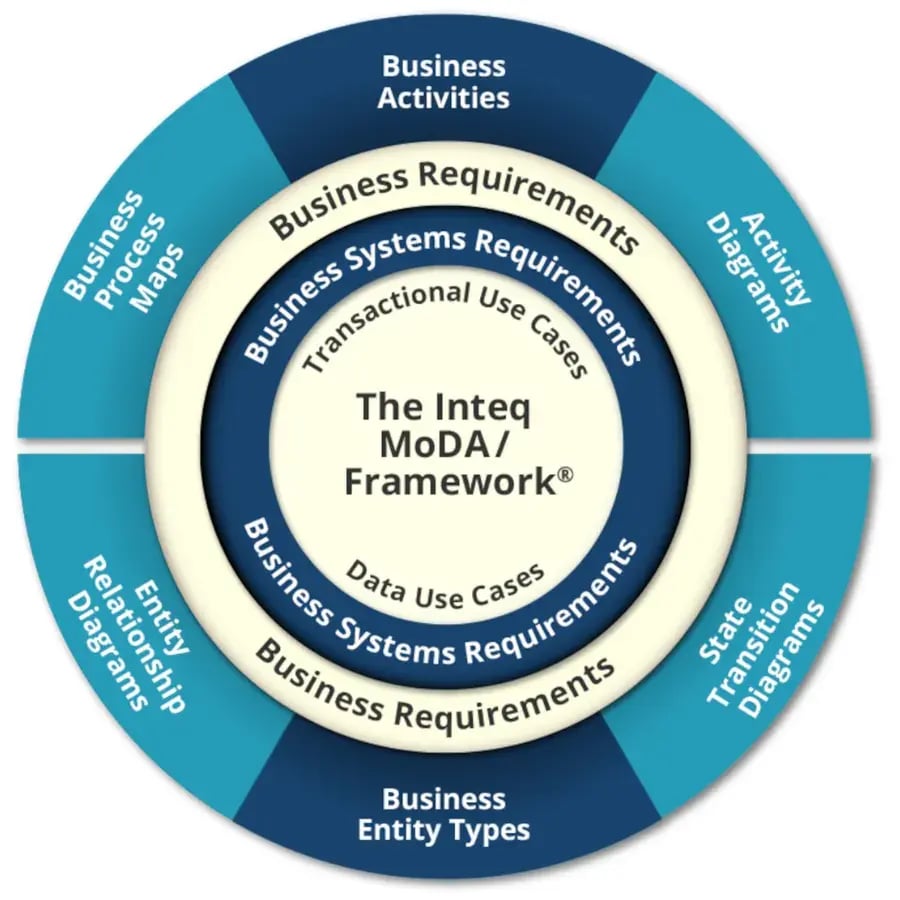
MoDA connects the models used to define business meaning, requirements, rules, structure, and behavior so the enterprise can move from analysis to design, build, test, and govern without repeatedly reinterpreting what the business requires.
Business requirements are not all equally volatile. Some describe the fundamental structure and meaning of the business. Others describe how the business operates today and must continue evolving as strategy, technology, regulation, and customer expectations change.
Core business entities, relationships, definitions, and rules of integrity tend to change incrementally over long periods. They form the semantic foundation on which systems, processes, requirements, and technology depend.
Processes, decisions, exceptions, and operating practices change far more frequently. They must evolve as the enterprise responds to new opportunities, technologies, constraints, and performance expectations.
Anchor change to the stable definition of the business so operations can evolve without repeatedly rebuilding the foundation beneath them.
Executed with rigor, MoDA creates a precise, governed, and machine-actionable representation of how the business understands itself. Core concepts, relationships, rules, states, and requirements are defined explicitly so people, systems, and AI can operate from the same understanding of the business.
Terms such as Customer, Order, Claim, Contract, Product, and Account may appear simple until different functions, systems, and teams define them differently. MoDA makes those meanings explicit and connects them to the relationships and rules that give them business significance.
The result is not merely shared terminology. It is a governed semantic foundation precise enough to become an enterprise asset.
Business and technology stakeholders work from explicit definitions rather than relying on local terminology, assumptions, or interpretations that change across teams.
Requirements, relationships, states, and business rules can carry forward into system design and implementation without being repeatedly reinterpreted at each handoff.
AI systems and agents gain a more coherent semantic foundation for interpreting business context, applying rules, understanding relationships, and supporting decisions.
A governed semantic foundation determines whether technology investments compound on a common understanding of the business or fragment around competing versions of it.
Business systems analysis and business process analysis have often developed as separate professional disciplines, with different practitioners, methods, vocabularies, and analytical perspectives. MoDA brings them together so the business can be understood through one coherent analytical discipline.
Focused on understanding and specifying the business requirements, structures, rules, information, and behavior needed to support systems and technology.
Focused on understanding how work flows through activities, decisions, roles, handoffs, exceptions, and operating practices across the business.
MoDA unifies systems analysis and process analysis under one framework. The same integrated models and analytical principles are applied and calibrated to the needs of the engagement, creating continuity across how the business is understood and specified.
Teams work from shared concepts, models, and analytical principles rather than reconciling different professional languages after the fact.
The organization reduces duplicative analysis practices and the effort required to reconcile inconsistent conclusions where disciplines meet.
Practitioners develop competency across systems and process analysis so the same discipline can be applied wherever the business needs to be understood.
Understand the business through one analytical discipline, then apply that discipline wherever systems, processes, or transformation require precision.
Ambiguity is inexpensive when it is discovered during analysis and expensive when it survives into delivery. MoDA resolves uncertainty early and produces requirements precise enough to guide what comes next without repeated interpretation at every handoff.
When uncertainty is surfaced while the business is being analyzed, stakeholders can clarify definitions, rules, requirements, and assumptions before they become embedded in design or implementation.
When ambiguity survives analysis, the organization pays for it later through conflicting interpretations, rework, implementation delay, and the loss of confidence that follows when delivered solutions do not match what the business actually required.
MoDA creates the opportunity to resolve uncertainty while it is still an analytical question, before it becomes rework, delay, and implementation cost.
MoDA produces unambiguous, build-ready specifications that carry forward from analysis into the activities responsible for turning requirements into working business capability.
Design decisions begin from requirements whose meaning, rules, structure, and expected behavior have already been specified.
Delivery teams build against explicit specifications rather than reconstructing business intent from fragmented documentation.
Validation can be anchored to the same requirements and business logic that originally defined what the solution must do.
The specifications remain available as a governed reference for understanding what the business requires as systems and processes evolve.
MoDA models are reusable analytical assets. They continue specifying the business long after the initiative that produced them has moved into production.
The greatest value from AI-assisted, specification-driven development does not come from generating the most code. It comes from giving AI specifications precise enough to direct what should be built, what should be tested, and what the business actually means.
MoDA creates rigorous business requirements, rules, definitions, relationships, states, and behavioral specifications that provide a more disciplined foundation for AI-assisted development and AI-enabled operations.
Rigorous requirements give AI-assisted development a clearer specification of the business capability, rules, structures, and behavior the resulting solution must support.
The same analytical specifications can anchor validation and testing, providing a consistent reference for determining whether the delivered capability matches what the business required.
MoDA provides the semantic and ontological foundation that gives AI agents a more explicit representation of the business concepts, relationships, rules, and context they must reason against.
When specifications are rigorous enough to direct development, support validation, and establish business meaning, AI can amplify a disciplined analytical foundation rather than magnify ambiguity.
MoDA's core analytical architecture has remained durable across changing technologies because it is grounded in something more fundamental: the disciplined specification of what the business is, how it operates, and what its systems and processes must support.
MoDA's core architecture has stood since 2010 because each new technology still depends on clear business meaning, sound requirements, explicit rules, and a disciplined understanding of how the enterprise operates.
The tools used to implement business capability continue to evolve, but the analytical questions beneath them remain remarkably consistent. What does the business mean? What must it do? What rules govern it? What information and behavior must the solution support?
Practitioners trained years ago and practitioners trained today can therefore work from the same underlying analytical discipline even as the technologies around them change.
MoDA is backed by decades of Inteq consulting engagements across business systems analysis, business process analysis, modernization, systems integration, and package selection.
That experience strengthens the framework with practical understanding of where ambiguity enters requirements, how analytical gaps propagate into delivery, and what is required to create specifications that remain useful beyond the immediate initiative.
Analytical methods create greater enterprise value when their usefulness survives the technology or project that first introduced them.
MoDA operates at the semantic layer within Inteq's three-framework methodology suite. Together, MoDA, BPR360, and AURA address three complementary dimensions of the enterprise: how business meaning is defined, how work operates, and how judgment is exercised across people and AI agents.
MoDA operates on the semantic layer, establishing precise business meaning through data models, business rules, requirements, states, decision logic, and related business specifications that support analysis, transformation, systems, and AI reasoning.
BPR360 operates on the operational layer, diagnosing how work flows across the enterprise, identifying process debt and structural dysfunction, reducing decision latency, and redesigning end-to-end business processes for stronger performance, coordination, and execution.
AURA operates on the cognitive layer, architecting how people and AI agents understand context, reason, exercise judgment, make decisions, operate within defined authority, escalate exceptions, and translate decisions into governed action.
Together, the three frameworks create an integrated discipline for defining the business precisely,
transforming how work operates, and architecting how judgment is exercised across people and AI agents.
MoDA provides the semantic and analytical foundation that enterprise systems, process transformation, and AI capabilities can build on. By defining business meaning, relationships, rules, requirements, and behavior precisely, MoDA gives people, systems, and AI agents a consistent representation of the business to understand, implement, and reason against.
MoDA is Inteq's proprietary model-driven analysis framework for rapidly identifying, analyzing, and specifying business systems and business process requirements through an integrated set of visual models. It creates a disciplined analytical foundation for defining what the business is, how it operates, and what its systems and processes must support.
Model-driven analysis uses integrated visual models to make business meaning, requirements, relationships, rules, structures, processes, states, and behavior explicit. Rather than relying primarily on narrative documentation, the models provide a more precise and connected representation of the business that stakeholders can analyze, validate, and carry forward into delivery.
MoDA treats requirements as reusable analytical specifications rather than temporary project documentation. The integrated models are designed to remove ambiguity early and preserve business meaning across design, implementation, testing, and governance so each handoff does not require the organization to reinterpret what the business originally required.
MoDA unifies business systems analysis and business process analysis under one analytical discipline. The same integrated models and analytical principles can be calibrated to the engagement, reducing duplicative practices and giving practitioners a shared way to understand business requirements across systems, processes, and enterprise change.
A semantic foundation is a precise, governed, and machine-actionable representation of how the business understands itself. MoDA makes business concepts, relationships, definitions, rules, and requirements explicit enough for people to agree on, systems to enforce, and AI capabilities to reason against.
Ambiguity discovered during analysis can often be resolved through stakeholder discussion. Ambiguity discovered after implementation creates rework, delay, and loss of confidence. MoDA produces forward-facing specifications designed to carry business intent through design, implementation, testing, and governance with less reinterpretation.
AI-assisted, specification-driven development is only as reliable as the specifications directing it. MoDA provides rigorous business requirements, rules, definitions, relationships, states, and behavioral specifications that give AI-assisted development a clearer basis for generating, implementing, testing, and validating business capability.
AI agents need a reliable representation of the business they are expected to understand and act within. MoDA creates semantic and analytical specifications that define business concepts, relationships, rules, states, and context, giving AI agents a more explicit foundation for interpreting information and reasoning about the business.
MoDA addresses the semantic layer of Inteq's methodology suite by defining business meaning precisely. BPR360 addresses the operational layer by transforming how work flows. AURA addresses the cognitive layer by architecting how judgment and decisions flow across people and AI agents. Each framework stands on its own, while together they create an integrated approach to semantic, process, and decision precision.
MoDA gives business and technology leaders a disciplined path to requirements the enterprise can build on. It creates precise, governed, and durable specifications that strengthen systems development, business process transformation, modernization, and AI-enabled initiatives.
Talk with Inteq about where MoDA can strengthen the analytical foundation of your enterprise and, where appropriate, how Inteq's BPR360 and AURA methodologies and Aperture agentic AI capabilities can extend that foundation across process transformation and intelligent operations.
Start a ConversationInteq brings together business systems analysis, business process analysis, process transformation, technology strategy, and agentic AI expertise to help organizations create stronger foundations for enterprise change.
Tell us a little about what your organization is working on. An Inteq team member will follow up to discuss your objectives and next steps.